Choosing a Wpc Fence Panel in 2026 requires more than comparing colors and prices. A convincing fence must survive sunlight, rain, temperature changes, and daily contact. It should also match your property’s drainage, soil, and maintenance conditions.
Dr. Amar K. Mohanty, a respected biocomposites researcher, has emphasized, “Performance must be judged across the product’s full life cycle, not by appearance alone.” That principle matters here. A panel may look like warm cedar in a showroom, yet fade beside a south-facing wall. A hollow profile may save money, but strong wind can expose weak posts and poor connections. Examine the recycled content, resin quality, wall thickness, surface coating, warranty, and installation instructions. Do not trust impressive claims without test evidence.
Small details matter.
Before purchasing, request a physical sample. Leave it outdoors for several days. Touch it after midday heat, then inspect its edges and surface. Ask how much the panel expands between winter and summer. Check whether the posts, rails, caps, and fasteners form one compatible system. Confirm local height, boundary, fire-safety, and setback requirements with the relevant authority. These checks reduce expensive corrections later.
The best choice is not always the thickest panel or the lowest quotation. It is the system that fits your climate, budget, privacy needs, and maintenance expectations. I would still question every “maintenance-free” promise. Weather always gets a vote. This guide explains how to compare Wpc Fence Panel construction, appearance, durability, sustainability, and total ownership cost before signing an order.
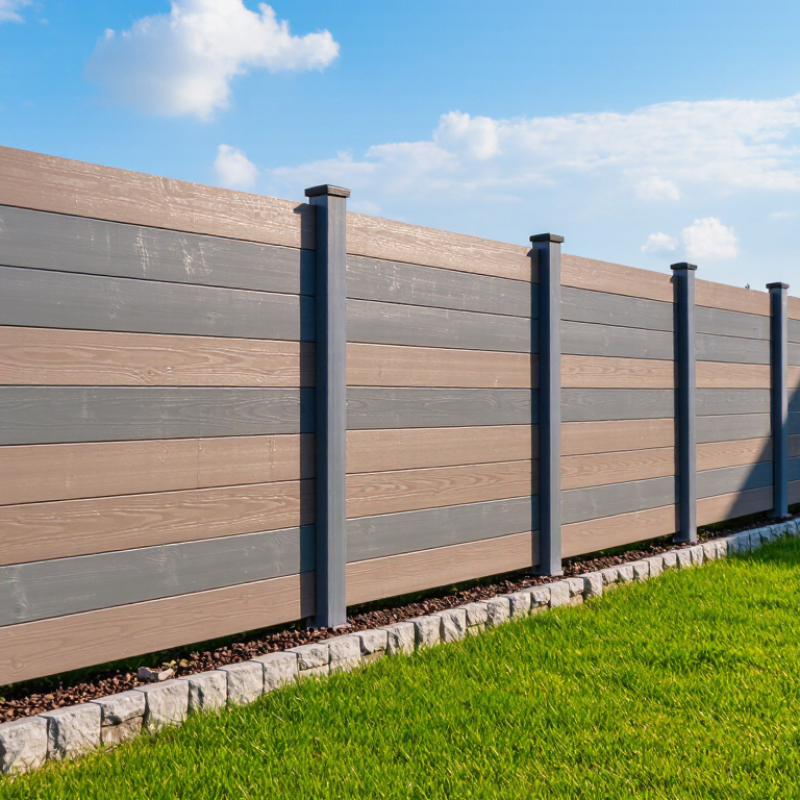
Define WPC Fence Panels by EN 15534 Composition and ASTM D7031 Testing
How to Choose WPC Fence Panels in 2026?
A reliable WPC fence panel starts with its composition. EN 15534 describes wood-plastic composites through wood content, polymer, additives, and manufacturing controls. Check whether the supplier provides a clear material declaration. Vague phrases like “premium composite” reveal very little. Ask for the wood-polymer ratio, surface treatment, and recycled content. These details affect stiffness, moisture response, color stability, and thermal movement.
ASTM D7031 offers a practical framework for evaluating WPC products. It considers properties such as flexural strength, tensile behavior, water absorption, dimensional change, and resistance to weathering. Request test reports that identify the tested product, specimen size, conditioning method, and laboratory. A single strength number is not enough. Fence panels face wind, sun, rain, impact, and repeated expansion. Testing should reflect those conditions as closely as possible.
Look closely at the panel after installation. A rigid sample may still warp if posts are weak or gaps are too small. Leave movement space around rails and follow the stated fixing distances. I have seen attractive panels fail because installers treated composite material like timber. Standards improve comparison, but they cannot replace site judgment. Results can also vary between production batches. That is easy to overlook. Choose panels with traceable composition, relevant ASTM D7031 data, and installation guidance suited to your climate.
How to Choose WPC Fence Panels in 2026
Define WPC fence panels by EN 15534 composition and ASTM D7031 testing
How to read the chart: A representative WPC formulation contains a cellulose-based component, a thermoplastic polymer matrix, and a smaller additive package. The 60% cellulose, 35% polymer, and 5% additives shown here are an illustrative industry reference mix, not mandatory EN 15534 limits. When selecting fence panels, request the actual formulation and verify that the product is evaluated for moisture resistance, dimensional stability, mechanical performance, weathering, and biological durability in line with the property areas covered by ASTM D7031.
EN 15534 describes wood-polymer and natural-fibre composite materials and relevant test methods. ASTM D7031 is a guide for evaluating mechanical and physical properties; neither standard creates one universal composition percentage or a single pass/fail value for every fence panel.
Compare Wood–Plastic Ratios, Density, Strength, and Recycled Content Data
How to Choose WPC Fence Panels in 2026?
Wood–plastic ratio strongly affects a WPC fence panel’s behavior. Common formulations contain 50–70% wood flour and 30–50% polymer by weight. Higher wood content can improve stiffness, but it may increase moisture movement and surface fading. The USDA Forest Products Laboratory’s Wood Handbook, FPL-GTR-282 (2021), confirms that wood-based materials respond noticeably to humidity. Ask for the exact ratio, not vague terms like “natural composite.”
Density is another practical checkpoint. Many exterior WPC profiles fall near 1.1–1.4 g/cm³, although additives and hollow designs change the result. Higher density does not automatically mean higher strength. Request flexural strength and impact data tested under ASTM D7031 guidance. A panel that feels heavy may still crack around screws. That detail is easy to miss.
Recycled content needs careful reading. “Recycled material” may include reclaimed wood fiber, recycled polymer, or factory scrap. These sources perform differently. The U.S. Environmental Protection Agency’s Sustainable Materials Management data shows recycled plastics vary significantly by resin and recovery route. Ask for percentages by material type and post-consumer content. Also check water absorption, screw pull-out, and color-change results after weathering. Laboratory data helps, but installation quality still matters. I would not trust one impressive number without its test temperature, specimen size, and conditioning period.
Evaluate Weathering, UV Resistance, Moisture Uptake, and Service-Life Ratings
How to Choose WPC Fence Panels in 2026?
Weathering performance should guide your WPC fence decision. Outdoor panels face rain, heat, frost, dust, and repeated temperature changes. Look for accelerated weathering test data, not only attractive color samples. UV resistance matters because direct sunlight can fade surfaces and weaken exposed polymers. Ask how much color change occurred after testing. A panel may look excellent indoors, yet age differently beside a sunny driveway.
Moisture uptake deserves equal attention. High absorption can cause swelling, staining, or internal stress after freezing. Check whether the manufacturer provides absorption figures and dimensional-change results. Examine cut edges, grooves, and fixing holes carefully. These areas often reveal weak protection. Service-life ratings are useful, but they are not promises. A quoted 20-year life depends on drainage, ventilation, installation, cleaning, and local climate. My practical view is simple: compare test conditions before comparing numbers. Some ratings sound precise but leave important details unclear.
Tips: Request full test reports, sample panels, installation guidance, and maintenance instructions. Place a sample outdoors for several weeks. Watch its color after rain and strong sunlight. Also, do not ignore fasteners and post spacing. Good panels can fail early when water remains trapped behind them. The “best” specification may still perform poorly on a shaded, damp boundary.
Check Panel Dimensions, Installation Loads, Fire Ratings, and Local Codes
How to Choose WPC Fence Panels in 2026?
Panel dimensions affect more than appearance.
A 1800 mm panel creates different post forces than a 1200 mm panel. Check panel width, thickness, weight, and thermal expansion before ordering.
ASCE 7-22 wind maps show basic wind speeds from 90 to 180 mph across the contiguous United States. That range is significant.
In exposed areas, use the project’s calculated wind pressure, not a supplier’s general claim.
Ask for tested span limits, post spacing, fastener type, and foundation depth.
Installation loads deserve careful attention.
A tall solid panel acts like a sail, especially beside open fields or coastal roads.
The 2024 International Building Code requires structural design according to local conditions, but fence rules may sit outside normal building permits. Confirm requirements with the local authority.
I have seen attractive layouts fail because gate posts were undersized. Small details matter.
Fire ratings can also mislead.
ASTM E84 reports flame-spread and smoke-developed indices, while NFPA 268 evaluates exterior wall assemblies under radiant heat. These tests are not interchangeable.
A WPC panel with a laboratory rating may still require clearances, noncombustible supports, or special spacing under local codes. Check the complete assembly, including posts and rails.
Recheck the documents.
Product literature sometimes leaves the mounting method unclear, and that weakness deserves honest review.
Calculate 2026 Costs from Panel Price, Labor, Maintenance, and Warranty Data
How to Choose WPC Fence Panels in 2026?
A reliable 2026 budget starts with panel dimensions, not the advertised unit price. Measure the fence line, then add 5% for cuts and damaged pieces. For 100 linear feet, 6-foot panels require about 18 panels if posts and spacing are included. At $45–$75 per panel, materials may cost $810–$1,350. Check whether posts, caps, brackets, and gates are included.
Labor often changes the final figure. Standard installation may range from $20–$45 per linear foot, depending on terrain, removal work, and local demand. A level yard could cost less. Sloped ground can require extra posts and concrete. Ask for an itemized quote. It exposes hidden charges.
Maintenance is usually modest, but not zero. Allow $0.50–$1.50 per linear foot yearly for washing, minor hardware replacement, and occasional repairs. A ten-year warranty sounds valuable, yet coverage may exclude fading, stains, wind damage, or installation errors. Read the warranty period and claim process carefully. My first estimate once ignored old-fence removal, adding nearly 20% to the project. That mistake was useful. Compare three written quotes, record every assumption, and keep a reserve of 10%–15% for site surprises. A cheaper panel may become expensive if its clips loosen or replacement colors no longer match.
How to Choose WPC Fence Panels in 2026? - Calculate 2026 Costs from Panel Price, Labor, Maintenance, and Warranty Data
2026 planning comparison for common WPC fence panel configurations in the United States. Costs are shown in USD and are based on typical residential project ranges, excluding gates, permits, demolition, difficult access, taxes, and regional delivery charges.
| WPC Panel Type |
Typical Dimensions |
Panel Price
per Linear Foot |
Post, Cap & Hardware
per Linear Foot |
Professional Labor
per Linear Foot |
Estimated Installed Cost
per Linear Foot |
Annual Maintenance
per Linear Foot |
Typical Warranty |
Estimated 10-Year Cost
per Linear Foot |
| Hollow WPC Privacy Panel |
6 ft wide × 6 ft high |
$22–$34 |
$12–$18 |
$20–$30 |
$54–$82 |
$0.50–$1.00 |
10–15 years |
$59–$92 |
| Solid WPC Privacy Panel |
6 ft wide × 6 ft high |
$30–$46 |
$14–$21 |
$22–$34 |
$66–$101 |
$0.60–$1.20 |
10–20 years |
$72–$113 |
| Wood-Grain Embossed WPC Panel |
6 ft wide × 6 ft high |
$34–$52 |
$15–$23 |
$23–$36 |
$72–$111 |
$0.70–$1.40 |
10–20 years |
$79–$125 |
| Decorative Slatted WPC Panel |
6 ft wide × 6 ft high |
$38–$60 |
$15–$24 |
$25–$40 |
$78–$124 |
$0.60–$1.30 |
10–15 years |
$84–$137 |
| Co-Extruded WPC Panel |
6 ft wide × 6 ft high |
$42–$68 |
$16–$25 |
$25–$40 |
$83–$133 |
$0.40–$0.90 |
15–25 years |
$87–$142 |
| Low-Height WPC Garden Panel |
6 ft wide × 3–4 ft high |
$18–$30 |
$10–$16 |
$16–$25 |
$44–$71 |
$0.40–$0.90 |
10–15 years |
$48–$80 |
Best Budget Choice
Hollow WPC privacy panels generally provide the lowest installed cost, especially when the fence is not exposed to severe impact or unusually high wind loads.
Best Long-Term Value
Co-extruded WPC panels usually have the highest initial price but can reduce fading, staining, and surface-maintenance costs over the service period.
Typical 100-Linear-Foot Project
A standard six-foot WPC fence commonly costs approximately $5,400–$13,300 installed before gates, old-fence removal, permits, taxes, and difficult-site surcharges.
Calculation method:
Estimated 10-year cost = installed cost + (annual maintenance × 10). For a 100-linear-foot fence, multiply the per-linear-foot figure by 100. Labor commonly varies with fence height, post spacing, concrete requirements, terrain, access, local wage rates, and removal of an existing fence. Warranty coverage normally depends on proof of purchase, installation conditions, color limitations, and exclusions for structural movement, misuse, storm damage, or improper cleaning.
Conclusion
Choosing a Wpc Fence Panel in 2026 requires more than comparing appearance and price. Start by confirming that the panel’s composition aligns with EN 15534 principles and that performance data is supported by ASTM D7031 testing or equivalent documentation. Review the wood–plastic ratio, material density, flexural strength, impact resistance, and recycled content to understand durability and environmental value. Also examine weathering results, UV resistance, moisture uptake, and stated service-life ratings, especially for regions with strong sunlight, heavy rain, or freeze–thaw conditions.
Practical installation details are equally important. Check panel dimensions, weight, fastening requirements, wind loads, fire performance, and compliance with local building codes. For an accurate 2026 budget, calculate the complete ownership cost, including panel prices, posts and hardware, labor, transportation, cleaning, possible repairs, and warranty coverage. A suitable selection should balance verified technical performance, installation practicality, long-term maintenance needs, and total cost rather than relying on appearance alone.

 Xiangying