Top 10 Types of WPC Fluted Panels for Global Buyers

Time:2026-10-12 Author:Isabella
0%

Choosing the right Wpc Fluted Panel is not simply a matter of matching color with a wall. Global buyers must compare material composition, flute depth, surface finish, moisture resistance, and installation requirements. A panel that performs well in a dry apartment may respond differently in a humid hotel lobby or a commercial showroom. This guide examines ten practical types, including wood-look, co-extruded, fire-rated, acoustic, waterproof, and outdoor-oriented options. Each type serves a different project need.

Real purchasing experience shows that small details often affect long-term value. Check panel density, backing quality, edge accuracy, and whether the supplier provides consistent batch samples. Ask for technical data, test reports, installation guidance, and clear warranty terms. Local building codes still matter. Certification accepted in one market may not satisfy another. That point is easy to overlook.

We will also consider cleaning, cutting, transport packaging, and replacement access. These issues seem ordinary, but they can increase project costs quickly. A beautiful fluted surface is not enough. Buyers should judge performance beside appearance, especially when panels face sunlight, water, or frequent contact. Some product claims deserve closer verification. Manufacturers may describe a panel as waterproof when only its surface resists moisture. Careful questions protect budgets and project quality. The following comparison offers a practical starting point, while leaving room for testing and professional review before large-scale purchase.
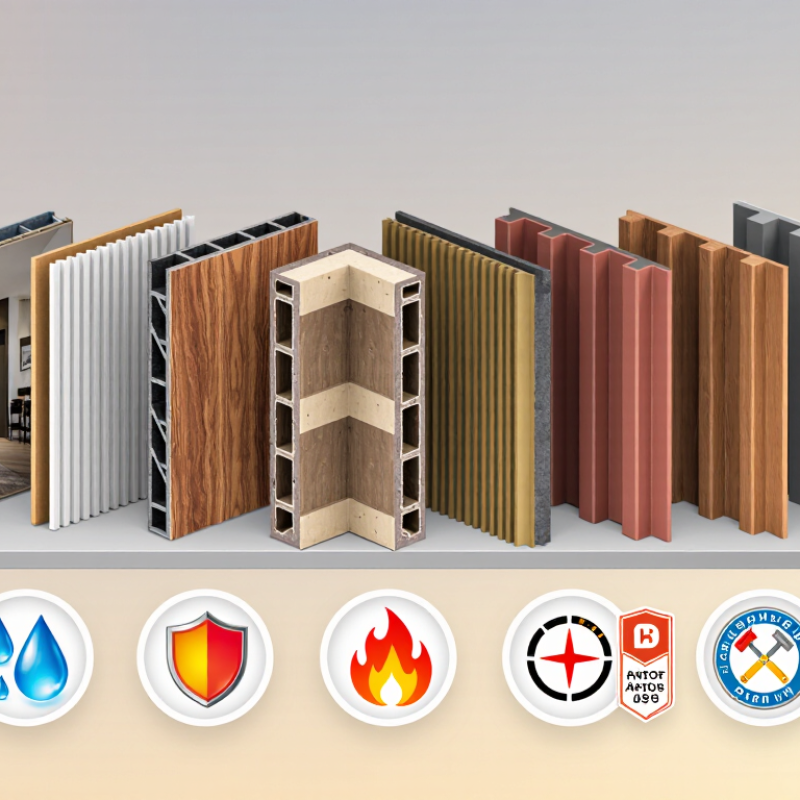
Top 10 Types of WPC Fluted Panels for Global Buyers

WPC Fluted Panels: Structure, Materials, and Core Features

WPC fluted panels combine wood fibers, thermoplastic resin, and performance additives. The wood content gives a warmer texture, while PVC or PE provides moisture resistance. During production, extrusion forms the panel into repeated grooves and a stable backing. Some profiles use a solid core. Others use hollow channels to reduce weight and material use.

The flute shape is more than decoration. It creates shadow lines, hides minor wall irregularities, and may soften reflected sound in suitable interiors. However, it should not be treated as certified acoustic insulation without test data. Panel depth, groove spacing, density, and installation gaps all affect performance. A deeper profile usually creates stronger visual rhythm, but it may collect more dust.

Core features matter in real projects. Buyers should check dimensional stability, screw-holding strength, surface hardness, color consistency, and resistance to moisture and ultraviolet exposure. Fire behavior also requires documented testing for the destination market. Do not rely only on a product brochure.

In humid locations, leave the expansion allowance recommended by the manufacturer. Poor ventilation behind the panel can still cause trouble. I have seen attractive installations fail because installers ignored uneven substrates and joint movement. That mistake is easy to repeat. Indoor and outdoor formulas are not automatically interchangeable. Request samples, technical sheets, and batch information before placing a large order. Surface texture may vary slightly between production runs, which can become visible under strong side lighting.

Top 10 Types of WPC Fluted Panels for Global Buyers

Structure, Materials, and Core Features

The chart compares representative flute-depth specifications commonly used across WPC panel categories. Micro-flute and narrow-groove panels are typically selected for fine decorative surfaces, while deep-flute, solid-core, and exterior panels generally provide stronger visual relief and greater design flexibility. Actual dimensions vary by construction, polymer type, wood-fiber content, additives, and manufacturer specification.

Classification of the Top 10 WPC Fluted Panel Types

Global buyers need a clear classification before comparing WPC fluted panels. Different reports measure different product scopes. Grand View Research estimated the global wood-plastic composite market at about US$7.4 billion in 2023, with growth above 7% annually through 2030. Mordor Intelligence placed the 2024 market near US$9 billion. The gap reflects varied definitions, not necessarily poor data.

A practical split includes ten types. Standard interior panels suit living rooms and offices. Moisture-resistant panels fit kitchens and covered wash areas. UV-stable exterior panels support façades and balconies. Co-extruded capped panels add a protective outer layer. Solid-core panels offer stronger impact resistance. Hollow-core panels reduce weight and installation effort. Acoustic slatted panels use gaps and backing layers to soften reflected sound. Fire-tested panels target projects requiring documented reaction-to-fire performance. Woodgrain-finished panels provide deeper visual texture. Custom-color panels support coordinated interiors. Details matter.

In field inspections, installers often confuse hollow structure with lower quality. That assumption is too simple. Geometry, density, resin content, and fastening design also affect performance. Buyers should request water absorption, dimensional stability, slip, and fire-test records. Laboratory figures still need site context. A panel performing well in a dry showroom may move after humid-season installation. That is imperfect. Regional climate, ventilation, and substrate movement deserve equal attention.

Surface Designs, Colors, Sizes, and Performance Differences

Top 10 Types of WPC Fluted Panels for Global Buyers

WPC fluted panels vary greatly in surface design, color, size, and performance. Common types include woodgrain, brushed, matte, embossed, stone-look, two-tone, co-extruded, acoustic, UV-resistant, and tested fire-rated panels.

Woodgrain surfaces suit warm interiors, while stone-look finishes create a heavier architectural effect. Brushed and matte textures hide fingerprints better than glossy surfaces. Embossed grooves add stronger visual depth, but they may collect dust in busy areas.

Color choice affects heat absorption and visual scale. Dark brown, charcoal, and black panels can feel dramatic, yet they may become hotter in direct sunlight.

Oak, walnut, grey, and sand tones usually blend more easily with furniture. I often recommend checking a physical sample first. Screen colors can mislead buyers.

Panel sizes commonly range from narrow decorative strips to wide boards around 150–300 millimeters. Lengths may reach three meters or more, depending on production limits. Deeper flutes improve shadow lines, while wider flutes create a calmer appearance.

Some panels include acoustic backing, but sound reduction depends on the wall system and installation gap. Exterior panels need verified UV and moisture resistance. Fire-rated products require independent test reports, not vague supplier claims.

I have seen projects fail because designers compared color only. Expansion gaps, substrate flatness, and fastener spacing also affect the final result. Performance data deserves equal attention.

Global Applications and Selection Criteria for Buyers

Top 10 Types of WPC Fluted Panels for Global Buyers

Global buyers use WPC fluted panels in hotels, offices, retail spaces, homes, and covered outdoor areas. Common options include oak-look, walnut-look, stone-look, solid-color, co-extruded, acoustic, moisture-resistant, UV-stable, narrow-slat, and wide-slat panels. Each type serves a different visual or performance goal.

Interior panels often suit feature walls, reception desks, ceilings, and media rooms. Acoustic versions can soften echoes in restaurants and meeting areas. Moisture-resistant panels may work in humid rooms, but they should not replace waterproof systems. UV-stable products are more suitable for shaded exterior walls. However, outdoor performance depends on the complete installation, not only the panel.

Buyers should compare density, core composition, surface film, groove accuracy, color consistency, and fixing methods. Ask for technical data, installation guidance, sample pieces, and independent test reports. Check resistance to moisture, impact, fading, and temperature changes. Local climate matters. A panel tested in a dry region may behave differently in coastal humidity. That point is easy to overlook.

Tips:

Match panel depth with lighting and room scale.
Narrow flutes create a refined rhythm, while wide flutes feel stronger and more architectural.
Confirm batch color before ordering.
Allow for expansion gaps, especially in warm climates.
Review the supplier’s packaging carefully; damaged edges create expensive delays.
Some selections look attractive online but feel too plastic in person.
Always inspect a physical sample.

International Standards, Installation, and Purchasing Considerations

Top 10 Types of WPC Fluted Panels for Global Buyers

International Standards, Installation, and Purchasing Considerations

WPC fluted panels vary by flute depth, surface finish, core density, and moisture resistance. Common options include interior wall panels, exterior cladding, acoustic panels, co-extruded panels, and fire-rated profiles. A 2023 Grand View Research report estimated the global wood-plastic composites market at about USD 7.2 billion. This growth increases choice, but also increases specification risks. Buyers should request density, water absorption, thickness tolerance, and test methods. Do not rely on appearance alone.

International compliance needs careful checking. EN 15534 addresses wood-plastic composite profiles and related performance characteristics. EN 13501-1 supports fire classification for construction products. ASTM D7032 and ASTM D7031 can provide useful reference points, although they were developed mainly for structural WPC applications. Formaldehyde emissions should be tested under recognized indoor-air procedures, such as EN 16516. Certificates must match the exact panel structure, not merely a similar product.

Installation often decides real performance. Allow expansion gaps at panel ends and around corners. Use corrosion-resistant fasteners in humid or coastal areas. A 3-millimeter gap may be insufficient when temperature changes are large. Check the supplier’s expansion calculations. This detail is often missed. Store panels flat, dry, and away from direct sunlight before installation. For exterior projects, confirm UV resistance through accelerated weathering data, such as ISO 4892-3 testing. One assumption deserves review: a thicker panel is not always stronger. Poor backing, weak clips, or incorrect spacing can still cause warping. Trial installation remains worthwhile.

FAQS

What are the main types of WPC fluted panels?

Common types include woodgrain, brushed, matte, embossed, stone-look, two-tone, co-extruded, acoustic, UV-resistant, and fire-rated panels. Each type offers different visual and performance benefits.

Which surface finish works best for busy interiors?

Brushed and matte finishes usually hide fingerprints better than glossy surfaces. Embossed grooves add depth, but dust may collect inside them.

How should buyers choose panel colors?

Dark brown, charcoal, and black create a dramatic appearance. However, direct sunlight can make them hotter. Oak, walnut, grey, and sand tones often blend more easily with furniture. Check a real sample. Screen colors can mislead buyers.

What panel sizes and flute designs are available?

Panels may range from narrow decorative strips to boards about 150–300 millimeters wide. Lengths can reach three meters or more. Deeper flutes create stronger shadows, while wider flutes look calmer.

Do acoustic fluted panels always reduce noise effectively?

No. Sound reduction depends on the backing, wall structure, installation gap, and surrounding surfaces. An acoustic panel alone may not solve the problem. Test the complete wall system when possible.

What performance data should international buyers request?

Request density, water absorption, thickness tolerance, moisture resistance, and testing methods. Exterior panels also need verified UV resistance. Appearance is not enough.

Are fire-rated claims reliable without supporting documents?

Fire-rated products should include independent test reports for the exact panel structure. A general certificate may describe a different product. Vague claims deserve careful review.

What installation details affect long-term performance?

Allow expansion gaps at panel ends and corners. Use corrosion-resistant fasteners in humid or coastal areas. Store panels flat, dry, and away from sunlight. Check substrate flatness and fastener spacing before installation.

Is a thicker WPC panel always stronger?

No. Weak backing, poor clips, or incorrect spacing can still cause warping. A thicker panel may look safer, but that assumption needs review. Trial installation is worthwhile.

Conclusion

Wpc Fluted Panel is a versatile architectural material made from a wood-plastic composite that combines the visual warmth of timber with improved resistance to moisture, insects, and everyday wear. This guide introduces the structure, material composition, and core features of the top 10 panel types, including standard fluted, deep-groove, narrow-groove, co-extruded, fire-retardant, acoustic, outdoor, lightweight, decorative, and customized options. It compares their surface designs, colors, dimensions, textures, and performance characteristics to help buyers understand how each type suits different projects.

The article also reviews global applications in residential, commercial, hospitality, and public spaces, while explaining key selection factors such as climate, installation location, maintenance needs, and budget. Buyers will find practical guidance on international quality expectations, product testing, packaging, delivery, installation methods, and expansion allowances. By evaluating appearance, durability, environmental conditions, and project requirements together, international purchasers can select a Wpc Fluted Panel solution that offers reliable performance and a consistent decorative finish.


Isabella

Isabella

Isabella is a dedicated marketing professional with a sharp focus on driving brand growth and engagement through strategic content creation. With an extensive background in digital marketing, she combines her passion for storytelling with her keen understanding of industry trends to deliver......